 By Caleb Morgan
Updated November 2026
A battery backpack leaf blower suits homeowners who want the airflow of a larger machine without the noise, fumes or pull-starting of a gas engine. This guide compares seven cordless backpack models that are widely listed for residential yards. Selection criteria were airflow (CFM), top air speed (MPH), battery capacity, harness comfort, and the warranty and battery system each brand offers, drawn from manufacturer specifications and common owner feedback.
Our top picks at a glance
- 1
 TOP CHOICEBest overallGreenworks 80V 800 CFM Cordless Backpack Blower with Leaf TarpView on Amazon
- 2
 TOP CHOICEBest for heavy debrisWORX 80V Brushless Backpack Leaf Blower WG572View on Amazon
- 3
 TOP CHOICEBest for mid-size yardsSENIX 60V Backpack Leaf BlowerView on Amazon
- 4
 Best for light-duty useGreenworks 60V Backpack Leaf BlowerView on Amazon
- 5
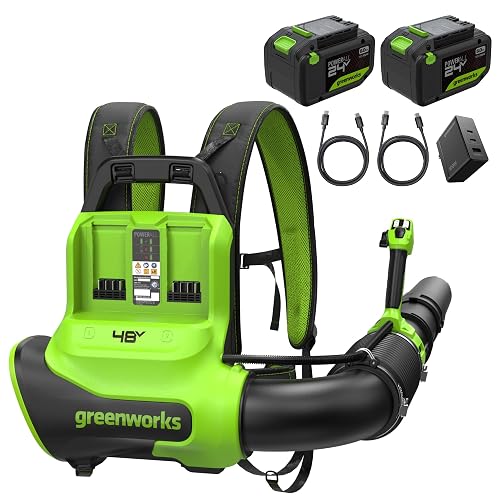 Best for dual-battery runtimeGreenworks 48V (24V x 2) 730 CFM Backpack Leaf BlowerView on Amazon
- 6
 Best for a compact kit40V HP Brushless 850 CFM Backpack Blower KitView on Amazon
- 7
 Best for gas-level powerLeafblower for leaf removal featuring back pack blower, 2-Cycle, 270-MView on Amazon
Our Top Picks
| Product | Best for | Key feature |
|---|---|---|
| Greenworks 80V 800 CFM Cordless Backpack Blower | Overall balance | 800 CFM, leaf tarp included |
| WORX 80V Brushless Backpack Leaf Blower WG572 | Heavy debris | 150 MPH, brushless motor |
| SENIX 60V Backpack Leaf Blower | Mid-size yards | 950 CFM, two 6.0Ah batteries |
| Greenworks 60V Backpack Leaf Blower | Light-duty use | 550 CFM, 5.0Ah battery |
| Greenworks 48V 730 CFM Backpack Leaf Blower | Long sessions | Two 8.0Ah batteries |
| 40V HP Brushless 850 CFM Backpack Blower Kit | Compact kit | 850 CFM brushless power |
| Husqvarna 150BT Gas Backpack Leaf Blower | Gas-level power | 270 MPH, 2-cycle engine |
Greenworks 80V 800 CFM Cordless Backpack Blower with Leaf Tarp
Greenworks 80V 800 CFM Cordless Backpack Blower with Leaf Tarp – 4.0Ah Battery & Rapid Charger, Cruise Control, Turbo Button, 4 – Year Warranty
Best for: Overall balance of airflow, runtime and convenience.
This model suits owners with medium to large lawns who want strong airflow and a tarp for gathering leaves quickly. Its 800 CFM rating is listed by the manufacturer for clearing wet and dense debris.
Pros
- Cruise control reduces trigger fatigue on long jobs.
- Four-year warranty listed by the brand.
Cons
- Heavier than the 60V models when fully loaded.
WORX 80V Brushless Backpack Leaf Blower WG572
Brushless, 800 CFM & 150 MPH Airflow, Sonic Turbine Fan, Variable Speed, 4×5.0Ah Batteries & Power Tank Included, PowerShare WORX Backpack Leaf Blower, 80V Electric Blower for Heavy-Duty Tasks, WG572
Best for: Heavy debris and wet leaves.
Suited to yards with large oak or maple leaf loads and damp clippings. The listing specifies 800 CFM and 150 MPH with a brushless motor and four 5.0Ah batteries.
Pros
- Brushless motor and variable speed control.
- Batteries and power tank are included in the listing.
Cons
- Bulkier pack than single-battery models.
SENIX 60V Backpack Leaf Blower
2400W Brushless Cordless Leaf Blowers,4 Speed Mode, Dual Port Fast Charger SENIX 60V Backpack Leaf Blower, 950CFM/140MPH,2 X 6.0Ah Batteries
Best for: Mid-size yards that need steady power.
A fit for homeowners with a quarter-acre or so of lawn and mixed debris. The listing cites 950 CFM and 140 MPH with two 6.0Ah batteries and four speed modes.
Pros
- Four speed modes for matching power to the job.
- Dual-port fast charger listed.
Cons
- Less brand history than the larger names.
Greenworks 60V Backpack Leaf Blower
Backpack harness spreads weight, Cordless, Powerful Performance for Yard Maintenance, Heavy Duty Debris Removal Greenworks 60V Backpack Leaf Blower, 550 CFM, 5.0 Ah Battery and Charger
Best for: Light-duty cleanup and smaller yards.
Suited to owners who mainly clear fresh leaves and patio debris. The listing states 550 CFM with a 5.0Ah battery and charger, and a harness designed to spread weight.
Pros
- Harness spreads weight across the shoulders and hips.
- Shares a battery platform with other Greenworks tools.
Cons
- Lower airflow than the 80V models for wet debris.
Greenworks 48V (24V x 2) 730 CFM Backpack Leaf Blower
Turbo Button / Variable Speed Trigger / Low Noise / Push Button Start / 3 Year Warranty Greenworks 48V (24V x 2) 730 CFM Backpack Leaf Blower, (2) 8.0 Ah Batteries
Best for: Longer sessions on larger lots.
Owners who want to swap batteries rather than wait for a charge will find this useful. The listing specifies 730 CFM with two 8.0Ah batteries and a three-year warranty.
Pros
- Two 8.0Ah batteries support extended runtime.
- Low-noise design with push-button start.
Cons
- Two-battery setup adds weight to the charging routine.
Buying Guide
Airflow (CFM) and Air Speed (MPH)
Airflow in cubic feet per minute (CFM) determines how much debris a blower can move, while air speed in miles per hour (MPH) determines how well it dislodges wet or stuck material. For most home yards, a blower in the 500 to 800 CFM range handles dry leaves and light debris well, while higher numbers help with heavier, damp clumps.
Battery Voltage, Capacity and Runtime
Higher voltage generally means more power, and amp-hour (Ah) ratings indicate how long a battery can run before it needs charging. If your yard is large, look for models that include two batteries or that work with a spare battery you can swap in, since runtime often limits how much you can clear in one session.
Harness Comfort and Weight Balance
A backpack blower is worn for the length of your cleanup, so padded shoulder straps, a supportive hip belt and a well-balanced frame matter. Check whether the harness is adjustable so it fits your frame, and consider how the blower sits on your back when you bend or walk on slopes.
Noise Level and Controls
Battery models are generally quieter than gas units, which can matter if you work early in the morning or have close neighbors. Variable speed triggers, cruise control and turbo buttons let you match the airflow to the job, which can also help you manage noise and battery life.
Warranty and Battery Platform
Warranty length and the brand’s battery ecosystem affect long-term cost. If you already own tools from a brand that uses the same battery platform, buying a compatible blower can save money, and a longer warranty offers more reassurance on a significant purchase.
FAQ
Is a battery backpack leaf blower powerful enough for a large yard?
Many battery backpack models in the 700 to 950 CFM range are capable of handling large yards, especially when paired with a spare battery. Runtime is the main limit, so plan your cleanup in sections and keep a charged battery ready.
How long does a backpack blower battery last per charge?
Runtime depends on the battery’s amp-hour rating, the speed setting you use and the density of the debris. Running at lower speeds generally extends the time you can work before needing a recharge.
Are cordless backpack blowers good for wet leaves?
They can handle damp leaves, though very wet or matted debris is harder to move than dry leaves. Higher airflow and air speed ratings tend to help with wet material, and a turbo or high-speed setting is useful for stubborn clumps.
Do I need a backpack blower instead of a handheld one?
A backpack model spreads the weight across your shoulders and hips, which reduces arm fatigue on larger properties. For a small patio or a short driveway, a handheld blower may be simpler and lighter to store.
How should I store a battery backpack blower over winter?
Store the blower and batteries in a dry place at moderate temperature, and avoid leaving batteries fully drained or exposed to freezing conditions. Follow the manufacturer’s storage guidance for the battery type you own.
Conclusion
Homeowners with large yards and heavy debris loads should look at the higher-airflow models with spare batteries, such as the 80V options from Greenworks and WORX. Those with medium yards or a tighter budget may find the 48V or 60V models a better match for their needs.
If comfort during long sessions is your top concern, prioritize a well-padded harness and variable speed controls. Choosing the model that fits your yard size, battery platform and daily workload will give you the most value.
Related reading
- Leaf Blower Types: Handheld, Backpack and Blower-Vac
- Battery Leaf Blower Guide: CFM, MPH and Runtime
- Backpack Leaf Blower Guide
- Stihl Leaf Blower Battery Power: 5 Best Picks Compared (2026)
- Stihl Leaf Backpack Blower Review: Key Features Explained
About Caleb Morgan
Caleb Morgan is part of our editorial team and reviews and edits our garden hand tools & equipment guides, checking product details against manufacturer specifications and owner feedback.